
The Strongman

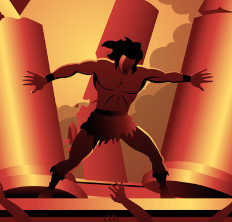
Everybody knows Samson...even people who don't know the Old Testament from a telephone directory have heard of the mighty strongman of the Bible, as well as his femme fatale Delilah (with a tip of the hat to Tom Jones).
Of course, there is a great deal more to the story of Samson than the pop culture images so many are familiar with (ditto for Delilah). And since other Old Testament characters with greater God-fearing moral character and more sterling reputations tend to get the lion's share of the attention and may be appropriately seen as types or foreshadowings of Christ, the following statement may come as a bit of a surprise:
The same can be said for an impulsive, hot-headed rake like Samson.
God-fearing moral character? Mmm...not so you'd notice. Sterling reputation? Anything but. In spite of Samson's copious character flaws, however, many Bible commentators view Samson as one of several types of Christ that populate the Old Testament.
Now, there are those who balk at the idea of viewing Samson as a type of Christ, typically because they tend to fixate on those copious character flaws. Samson gets largely ignored in this regard because it never occurs to most people that such an immature, self-centered, lust-filled excuse of a man can be compared to our Lord and Savior. And I have enough character flaws of my own that I can certainly appreciate their point of view.
What people should be reminded of, however, is that it's not necessary for someone to be on a level comparable to that of Christ in every aspect of their life and character to be seen as a foreshadowing of Him. After all, if that were truly the case, then taken to its logical extreme there'd be no such thing.
Interpretive note: While working on this article, I noticed that there appears to be some degree of confusion concerning the meaning of the word "antitype," which is a word you may come across in prophetically oriented material.
First of all, it is true that one legitimate meaning of the word "antitype " is "an opposite or contrasting type." For example:
"Democracy is an antitype of Communism."
That's because they are both types of government, but they could scarcely be any more different—they're virtual opposites in many ways. But that is not the word's primary meaning. The primary meaning of the word "antitype" is "the fulfillment of a type." For example:
"Christ is the antitype of Joseph."
In other words, Jacob's son Joseph is clearly a type of Christ, which means Jesus is the fulfillment of the type established by Joseph. So Christ is his antitype. This last meaning is normally the only meaning of this word used by Bible commentators in applications to Scripture. Not pointing any fingers or saying any particular writer is right or wrong...I just want you to be aware of this difference in order to avoid confusion in case you read the work of someone who says something along the following lines (and I have):
"How on earth can Samson be a 'type' of Christ when there is so much contrast between them?! My goodness, Samson is more like an antitype of Christ!"
And since we're on the subject, note that the prefix "anti-" can mean "against," but can also mean "in place of." For example, the Antichrist may certainly be against Christ, but that's not what the word is intended to suggest. It is intended to be understood as "one who comes in place of Christ."
No, forget about Samson's character flaws. Forget about his numerous moral shortcomings, as bad as they were. Recognizing any particular person in the Old Testament as a type of Christ simply means that certain aspects or events of their life (warts and all) exhibit some significant typological parallels to Christ and what He accomplished.
And as flawed as Samson was as
a person, his life certainly "exhibits
some significant typological parallels
to Christ and what He accomplished."
And as we will see, one of the fascinating things about Samson is that not only is he a type of Christ, but he also serves as a type of Israel at a critical juncture in the history of the Jewish nation.
So put away your barbells and join me as we journey back to the eleventh century BC to learn more about this Old Testament strongman, and about his foreshadowings of both Christ and the nation of Israel.
A little background
To understand Samson's biblical significance, we need to briefly review the state Israel was in during that general time frame (and how they got there).
The book of Judges outlines events that occurred after the death of Joshua, who initially led the Israelites into the Promised Land and began a series of conquests to drive out the Canaanites from the land as God had commanded them (Josh. 6–12). But the subjugation of the land was not completed under Joshua, and Judges gives us some historical and theological commentary on what Israel went through over the next three to four centuries.
As I said, God had commanded Israel to completely drive out all the groups of pagan people from the land of Canaan (Deut. 7:1–6; Josh. 1:1–9). God wanted to prevent idolatry and the moral corruption it fosters from influencing His people, so this command to drive out all the Canaanites went hand in hand with Israel's call to remain faithful to the LORD.
But is that what we see? Uh, not exactly. Well, what do we see?
• In spite of the miraculous victories God had given them, we begin to see an overall waning of Israel's resolve to follow through on God's command. They simply began allowing groups of Canaanites to remain, and as a result their pagan practices gradually crept into the lives of God's people (Judg. 2:1–3).
• Israel grew complacent after portions of the land were secured, and they began to exhibit diminishing trust in the LORD's promises. This led to further compromise in Israel's obedience and they increasingly turned to idolatry, which caused the LORD's anger to burn against them (Judg. 2:11–15).
• Practical economic concerns emerged, as Israel found it far more pragmatic to subjugate groups of Canaanites into forced labor rather than completely eliminate them as God had commanded (Judg. 1:28). In other words, short-term economic benefits outweighed complete obedience to the LORD.

So, the book of Judges tells the tale of Israel spiraling ever deeper into apostasy after the death of Joshua as they compromise their efforts to drive the Canaanites out of the land, as well as increasingly compromise their worship of and obedience to the LORD.
We read about Samson in Judges 13–16, and he appears near the end of the time of the judges. During the roughly 350 years under the judge system, Israel repeatedly went through the following cycle:
1. Israel is at peace.
2. Israel falls into apostasy and drifts away from God.
3. Israel is oppressed by their enemies.
4. Israel cries out to God for deliverance.
5. God raises up a deliverer (who becomes the next judge).
6. God delivers Israel.
7. Israel returns to a condition of peace.
Rinse and repeat. But by the time we get to Samson's time as judge, this cycle was beginning to break down. Their oppressors at the time were the Philistines, but by this time the people of Israel had reached the point where they didn't bother to cry out to God for deliverance.
And that serves as a barometer that indicates how far they had fallen.
Israel had come to the place where they would do anything except obey and place their faith in God and cherish their covenant relationship with Him. Rather than driving out the pagans from the land God had promised them, they were either enslaving them, being oppressed by them, making compromised efforts to get along with them, or flat-out assimiliating with them. In other words:
Israel had reached the point where their covenant with the God who had miraculously delivered them from slavery in Egypt was a fading relic.
So it's not too difficult to understand why God knew it was time to start shaking things up a bit for His covenant people Israel...
And that shaking began with Samson.
What I want to do here is first run down a Top 10 list of parallels between Samson and Christ that show various ways that this Old Testament strongman is indeed a type or foreshadowing of the coming Messiah.
I also want to discuss five ways that Samson serves as a type of Old Testament Israel, particularly as the nation was during the general time frame of the book of Judges. And when we get to that part, you can be sure of one thing:
A few of Samson's copious character flaws will come into play.
Samson as a type of Christ
1. Both experienced miraculous births.
The first thing Samson has in common with Jesus is that his birth was miraculous in nature. Samson's mother was barren (she may have been past child-bearing age, but Scripture doesn't specifically say), and an angel of the LORD appeared to her and told her she would bear a son:
2And there was a certain man of Zorah, of the family of the Danites, whose name was Manoah; and his wife was barren, and bore not. 3And the angel of the LORD appeared to the woman, and said to her, Behold now, you are barren, and bore not: but you shall conceive, and bear a son. 4Now therefore beware, I pray you, and drink not wine nor strong drink, and eat not any unclean thing: 5For, see, you shall conceive, and bear a son; and no razor shall come on his head: for the child shall be a Nazarite to God from the womb: and he shall begin to deliver Israel out of the hand of the Philistines. [That was Samson's God-ordained mission in life (see no. 2 below).]
(Judges 13:2–5 AKJV / emphasis & [comments] added)
This is no small matter, because throughout the entire Bible the conception and birth of a child is only foretold to a woman by an angel of the LORD four times—twice in the Old Testament and twice in the New:
• Isaac (Gen. 18:10)
• Samson (Judg. 13:2–5)
• John the Baptist (Luke 1:13–17)
• Jesus (Matt. 1:20–21)
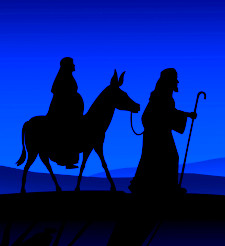
The mothers of Isaac, Samson, and John the Baptist were barren and/or beyond natural child-bearing age, and Mary the mother of Jesus was only betrothed to her husband Joseph, and they had not yet consummated their marriage. In other words, she would have been considered a woman who had no business becoming the "round yon virgin" we sing about at Christmas time, if you catch my drift.
Born to be wild: Some people count Ishmael in this, but the angel of the LORD told a (fertile) Hagar she would bear a son when she was already with child. Not quite the same thing. The angel of the LORD just told Hagar that the child she was carrying would be a boy and to name him Ishmael—and that he'd be a wild man who would always be in conflict with others (Gen. 16:11–12).
In Samson's case, the angel of the LORD also told his mother some intriguing information about her son's future.
2. Both were set apart for a divine calling.
So the angel of the LORD told Samson's mother that he was to be a Nazarite (also spelled Nazirite) for his entire life starting from conception, and that he would "begin to deliver Israel out of the hands of the Philistines."
Don't miss this (and a lot of people do because they don't know their Old Testament history very well). If things had continued the way they were going for Israel at that time (trampling their covenant relationship with God underfoot and assimilating with pagan groups in Canaan), within a few centuries they might have been gone and all but forgotten.
Had it not been for the deliverance that God ordained for Samson to initiate, Israel may well have been consigned to the dustbin of history.
But God had other plans, and Samson played a key role in those plans.
Of course, Jesus was also set apart by His Father for a divine purpose, and that was to atone for the sins of mankind on a cross at Calvary—and not just to initiate but to completely accomplish our deliverance from the curse of sin and death that we brought upon ourselves in the Garden of Eden.
3. Both were empowered by the Spirit to perform miraculous feats.
The book of Judges records a number of Samson's incredible feats of strength, which is arguably the primary thing most people remember about him. But Scripture makes it clear that Samson's incredible strength did not come from him (and it didn't come from his hair, either...more on this later)—it came via the empowerment of the Holy Spirit. On several occasions (Judg. 14:6; 14:19; 15:14) Scripture tells us point blank that the "Spirit rushed mightily on him" to enable Samson to pull off some amazing feat of strength.
The Holy Spirit was with/upon Jesus from the moment of His conception, and was always present with Him to guide and empower Him. Throughout His entire ministry, He performed every single one of His miracles through the Holy Spirit, thus demonstrating His divine power and authority.
4. Both were rejected by their own people.
Keep reading.
5. Both were handed over to the enemy by their own people.
Jesus so enraged
the religious leaders
during His ministry
that they hated
and sought ways
to destroy Him.
Against his parents' wishes, Samson took a wife from among the enemy Philistines—a woman who "pleased him well." In Judges 15, we read that Samson went to visit his wife in Timnah, but her parents told him they had gotten the impression that he hated her and so had given her to another man. They offered Samson her younger sister, but Samson was enraged and sought vengeance on the local Philistines.
Samson caught 300 foxes and took them in pairs and tied their tails together. Then he attached a torch to the tails of each pair and turned them loose through the Philistines' grain fields and thus burned a large portion of them.
The Philistines learned that it was Samson who had done this, and they went to Timnah and killed his wife and her father. Samson "struck them with a great slaughter," and went to hide out in a cave.
Meanwhile, the Philistines gathered en masse against the Israelites in Judah, and the people in Judah inquired why they were gathering against them. The Philistines told them they were after Samson for what he had done to them, and three thousand men of Judah went to the cave where Samson was hiding and demanded to know why he had done such an outrageous thing. They were greatly distressed that Samson's reckless actions had caused the Philistines to rise up against them, and they tied Samson up and handed him over to the Philistines—and it took more Spirit-empowered feats of superhuman strength for Samson to get himself out of this mess.
The point is that Samson's own people turned against him, and as a result turned him over to their enemies.
Jesus so enraged the religious leaders during His ministry that they hated and sought ways to destroy Him. Everywhere Jesus went, the scribes and Pharisees did everything they could to damage His reputation and manufacture issues they could use to turn the people against Him.
Their efforts were successful to an extent, although Jesus still maintained a faithful following among the common people. In the end, they arranged for Him to be turned over to their enemies the Romans to be tried and convicted on false charges and brutally executed like a common criminal.
6. Both were betrayed by someone they loved.
In Judges 16, we read that Samson fell head over heels for a woman named Delilah, and the Philistines used her and her relationship with Samson to discover the secret to his great strength.
Three times Delilah begged Samson to tell her his secret, and three times she signaled the Philistines to come to get Samson while he slept only to discover that Samson was able to overcome them because he had lied to her and made up a silly story to conceal the truth.
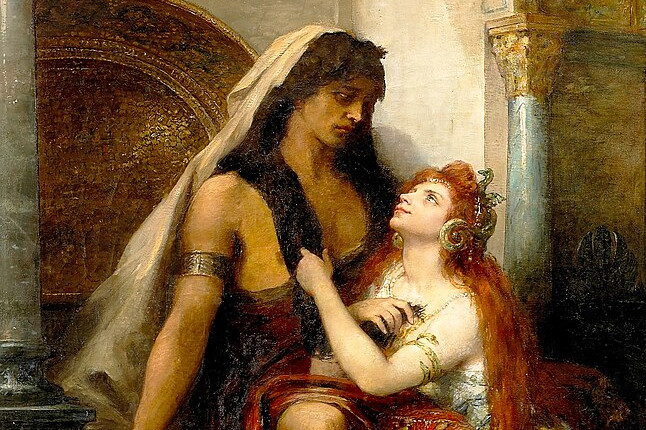
Finally, Delilah wore him down. Tired of her incessant pleading to know the secret to his strength, he finally confessed to her that no razor had ever touched his head. Leaving his hair uncut was one of his Nazarite vows, and the only one of which he had not yet broken. So while Samson slept, Delilah signaled for someone to come in and cut off his hair, and his Spirit-empowered strength was withdrawn from him.
Jesus was betrayed to the Romans by Judas, one of His 12 disciples. And I want to mention something here that I think is worth noting.
In Matthew 26:20–25, Jesus and His disciples are at the Last Supper and at one point during the meal Jesus states that one of them would betray Him. But notice their reactions:
20Now when evening had come, he was reclining at the table with the twelve disciples. 21As they were eating, he said, "Most certainly I tell you that one of you will betray me." 22They were exceedingly sorrowful, and each began to ask him, "It isn't me, is it, Lord?" 23He answered, "He who dipped his hand with me in the dish will betray me. 24The Son of Man goes even as it is written of him, but woe to that man through whom the Son of Man is betrayed! It would be better for that man if he had not been born." 25Judas, who betrayed him, answered, "It isn't me, is it, Rabbi?" He said to him, "You said it." [Note that the other disciples call Jesus "Lord," but Judas calls Him "Rabbi." Although Jesus was addressed as "Rabbi" by people on several occasions, some argue that under these circumstances, this suggests that, unlike the others, Judas saw Christ as a mere teacher as opposed to God in the flesh.]
(Matthew 26:20–25 / emphasis & [comments] added)
They were all genuinely perplexed as to who that traitor might be. In other words, clearly none of them had a clue that it would be Judas who would betray Him. But how is that possible?! I mean, after three and a half years, they must have had at least some indication that something didn't quite jive between Judas and Jesus if Jesus knew that Judas would betray Him, right?
But what the disciples' reactions at the table tell us is that Jesus never treated Judas any differently than any of the other disciples.
He loved Judas just as much as the others, and treated him accordingly.
7. Both suffered humiliation at the hands of their captors.
After Delilah's betrayal, the Philistines were able to keep a now-weakened Samson under their control. And the Philistines wasted no time in relishing their victory over their strongman enemy, who now wasn't so strong.
Hair today, gone tomorrow: Note that Samson's strength didn't literally reside in his hair—it came from the empowerment of the Holy Spirit. But his uncut hair represented his obedience to one of his three Nazarite vows, which also included abstaining from wine and anything containing grapes, and not going near a dead body of any kind (both of which he had already violated). So when his hair was finally cut, the Holy Spirit refrained from giving him strength as a result of his complete violation of all three of his Nazarite vows.
Later, the Philistines staged a feast to honor their god Dagon and celebrate their victory over their enemy Samson. All the leaders of the Philistines were in attendance, and Samson was brought out to "entertain" them. The Bible doesn't specify exactly what the Philistines made Samson do, but it was certainly something intended to make sport of the former strongman. And it must have been quite entertaining, because one thing cannot be denied:
Samson brought the house down.
Jesus was likewise mocked and humiliated by His Roman captors before He was crucified. After Pilate was finished sentencing Him to death by crucifixion, they took Jesus into the Praetorium where a garrison of Roman soldiers had a high old time with the King of the Jews:
27Then the governor's soldiers took Jesus into the Praetorium, and gathered the whole garrison together against him. 28They stripped him and put a scarlet robe on him. 29They braided a crown of thorns and put it on his head, and a reed in his right hand; and they kneeled down before him and mocked him, saying, "Hail, King of the Jews!" [In reality, the soldiers weren't just mocking Christ—they were mocking the Jews as well.] 30They spat on him, and took the reed and struck him on the head. 31When they had mocked him, they took the robe off him, and put his clothes on him, and led him away to crucify him.
(Matthew 27:27–31 / emphasis & [comments] added)
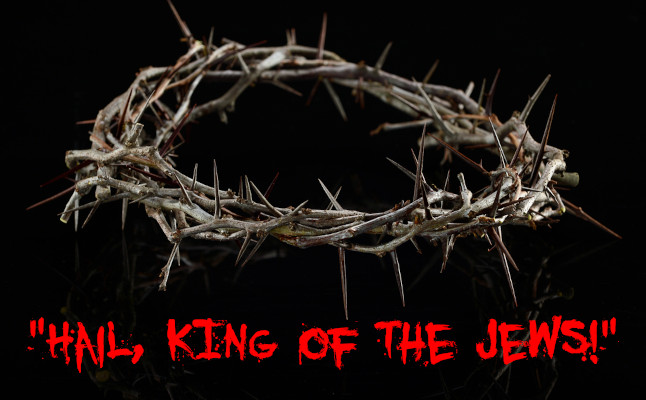
The mockery Jesus endured was the consummate irony: The One they were parading around as a wannabe "king" was in reality the true King of kings:
Matthew arranges this scene between the sentencing (27:24–26) and crucifixion (27:31–44) to present a crescendo of rejection: from Jewish leaders, to the Gentile governor, to common soldiers, the whole world scorns its rightful King. The Gospel's climax is that the mocked One is vindicated by resurrection (28:1–10), proving the mockery false and His kingship true.
— Bible Hub: Questions and Answers [Source]
8. Both sacrificed their lives to save many.
Keep reading.
9. Both of their deaths led to the defeat of the enemy.
Samson was well aware that as God gave him one last infusion of strength to bring the walls of the Philistines' temple tumbling down, he would be killed. Thus he sacrificed his life to trigger the beginning of Israel's deliverance from the Philistines—deliverance that would be accomplished under Samuel (think David and Goliath) and that would save the lives of many Israelites.
Christ also sacrificed His life to save many:
He sacrificed His life on the cross to save whosoever believes in Him.
And over the last two thousand years, the lives of untold legions of people have been saved from eternal death by believing in faith in the atoning sacrifice Christ made for their sin so they could inherit eternal life.
A sacrifice that defeated the enemies of sin and death.
10. Through faith, both found strength in weakness.
As a beleaguered Samson was standing between two pillars in the Philistines' temple during their celebration, he prayed that God would strengthen him one last time so he could pay back the Philistines for what they had done to him.
Hair it comes: Oh, remember what I said about the Holy Spirit refraining from giving Samson strength due to the violation of his third and final Nazarite vow of not having his hair cut? Well, during his time in captivity prior to the big shakedown in the Philistines' temple, something began to happen:
22However, the hair of his head began to grow again after he was shaven. [And I can just hear the Holy Spirit saying "OK, that's long enough."]
(Judges 16:22 AKJV / emphasis & [comments] added)
One last time, he had faith in his God—and the Holy Spirit empowered him to push those pillars hard enough to cause them to buckle. This initiated a chain reaction that led to the collapse of the entire temple, killing thousands of Philistines—including their leaders—who were inside and also up on the roof.
Through faith, Samson found strength in his weakness.
The point is that this final act of faith is why Samson is mentioned in Paul's Faith Hall of Fame in Hebrews 11.
As Christ hung on the cross, He was at His greatest moment of physical weakness—and His faith in His Father never wavered. And His Father's power was perfected in the weakness of His crucified Son. So in a spiritual sense...
Christ was at His strongest when His torn,
bloodied body became our sin on the cross.
Arguably there are a few other various ways in which Samson could be said to be a type of Christ, but these are my Top 10.
As I said, Samson is not just a type of Christ—he is also a type of Israel, especially the way the Jewish nation had become during the time frame of the book of Judges.
Samson as a type of Israel
1. Both were chosen by God.
Samson was called by God before he was ever conceived to be a Nazarite who would begin the deliverance of Israel from the Philistines (Judg. 13:3–5). And despite a life filled with flaws and failures, he did just that.
Israel was a people chosen by God for four fundamental reasons:
• Israel was to be the vehicle through which God would give man His written Word. They were to write down the things God said and did as the Holy Spirit moved upon them and preserve them with absolute accuracy (Isa. 42:9).
• Israel was to be God's witnesses on earth that He existed and was the only God (Isa. 43:10–12). That is, the miracles He performed on their behalf and His manifest presence among them was to prove to all mankind that He and He alone was the one true God.
• Israel was to be the instrument through which God would be glorified on earth (Isa. 49:3).
• Israel was to be the channel through which the Messiah would come to bring salvation to the world (Isa. 49:6).
And despite a history filled with flaws and failures, they did just that.
2. Both were reckless and immature.
Throughout his life, Samson displayed reckless and immature behavior. He was the type of man who invariably "did what was right in his own eyes" (which was becoming a dishearteningly common attitude among the people of Israel).
He insisted on marrying a Philistine woman against his parents' wishes (Judg. 14:1–3). After losing a foolish bet based on a silly riddle with some Philistine men, he killed 30 Philistines to pay off what he owed (Judg. 14:8–20). He burned the Philistines grain fields after his father-in-law gave his wife to another man, and so on and so forth.
Similarly, as we progress through the time of the judges, we also see Israel becoming more and more reckless and immature. They showed increasingly less regard for God and their covenant with Him, an increasingly greater propensity to worship false gods, and increasingly less interest in the worship of, obedience to, and faith in the God who had miraculously delivered them from bondage in Egypt. In other words, for most Israelites...
Their covenant with God had become
little more than historical baggage.
3. Both were lured into sin by foreign women/gods.
One thing about Samson is beyond dispute: He had an eye for the babes. And throughout his story we see him being driven by lust and being lured into questionable relationships with women. And to make matters worse...
He invariably went after the wrong women.
As I mentioned in nos. 5 and 6 above, Samson's Philistine wife got him in big trouble with Israel, and Delilah ended up being his complete undoing. Some speculate that Delilah was also a Philistine, but the Bible doesn't actually say.
Throughout Scripture, the worship of idols is likened to prostitution, and Israel had acquired quite the cathouse full of false gods during their time as slaves in Egypt. But the worship of idols continued to plague Israel even after God delivered them from their oppression under Pharaoh.
After some initial successes in eliminating various pagan groups from the Promised Land under Joshua, after his death they began to stumble through the cycle I mentioned earlier, where they would be at peace, begin to fall into idol worship, come under attack, cry out to God, be delivered by God, and be at peace again. Then the cycle would invariably start over. In other words:
Samson couldn't say no to the ladies,
and Israel couldn't say no to the idols.
4. Both ended up in bondage due to sin.
Samson was in it so deep with Delilah that he did the unthinkable—he shared with her the secret to his strength, and she promptly took advantage of it to weaken and entrap him. The Philistines took him into custody, gouged out his eyes, and proceeded to take delight in humiliating him. In other words:
Samson's sin ended up placing him in bondage.
God had made it crystal clear to Israel that He expected them to love and obey Him and honor their covenant with Him, and that He would greatly bless and prosper them if they did so. And He made it equally clear to them that there would be consequences—that He would judge and punish them—if they failed to do so (Lev. 26; Deut. 28). And such failure certainly included succumbing to the whoredom of worshiping false gods.
Which they did, and so did He.
By the time Samson came along, Israel had fallen under the heels of the Philistines and had given up on the idea of crying out to God for deliverance and succumbed to the bondage of compromise and apostasy.
So just as with Samson, Israel's sin ended up placing them in bondage.
5. Both cried out to God for deliverance.
Note that at this final celebration of the Philistines where they honored their god Dagon and thanked him for their victory over their enemy Samson, all the top leaders of the Philistines were present.
So when the Philistines' temple came crashing down on them, it basically wiped out their leadership and served as a graphic harbinger of their coming downfall—as well as a coming window of opportunity for Israel to begin to rise up and crawl out from under the Philistines' heel of oppression.
To get a sense of this, imagine someone nuking Washington, D.C. It would be adiós to the White House, the Capitol, the Pentagon, the State Department, the works. Our nation would come tumbling down in short order. (OK, all you Never Trumpers...settle down.)

As Samson stood between the pillars in that temple and endured the jeers and mockery of the enemy, his faith in God came to the fore one last time. Samson cried out for God to strengthen him one last time, and he knew full well his "deliverance" would crush both him and the Philistines:
28And Samson called to the LORD, and said, O Lord God, remember me, I pray you, and strengthen me, I pray you, only this once, [he knew once would be enough] O God, that I may be at once avenged of the Philistines for my two eyes. [See remarks below.]
(Judges 16:28 AKJV / emphasis & [comments] added)
Samson knew what he was going to do,
knew that he was going to die doing it,
and asked God for the strength to do it.
Note that even though Samson prayed in faith one last time for the strength to do what God had ordained for him to do all along, his prayer was still tinged with personal vengeance—Samson's self-centered immaturity was evident even at the pinnacle of his faith. But that didn't stop God from using him mightily.
Our personal flaws don't stop God
from using us—only our lack of
obedience in faith can do that.
As for the nation of Israel, all during the time of the judges they repeatedly fell away from God, allowed themselves to come under oppression from some enemy, and only then would they cry out to God for deliverance. God was faithful and would deliver them, but then they would start the cycle again.
This last time around, however, since Israel had fallen so far from God that they didn't cry out for deliverance, one might say Samson's final cry for strength effectively doubled as a cry from a man for God to deliver him from his personal bondage, as well as a cry from an Israelite for God to deliver the nation of Israel from its bondage, since it served to begin the deliverance of Israel from the Philistines.
And that was God's plan all along.
The real Strongman
Like I said, everybody knows Samson, the strongman of the Old Testament. But largely due to his many weaknesses and foolish, immature actions, this strongman and his key role in the history of the nation of Israel get overlooked by the majority of people...
Including yours truly up until recently, when the Holy Spirit lassoed me into this little study of Samson.
But it's fascinating how the life of this flawed individual serves as a beautiful type of Christ, as well as a type of the nation of Israel.
Oh, I almost forgot. While I was working on this article, the Holy Spirit smacked me upside the head with one last thing, and it just blew me away.
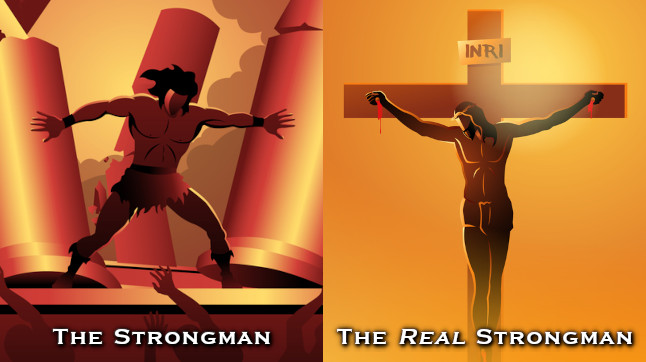
As this Old Testament strongman stretched out his arms to bring down the Philistines' temple to begin the deliverance of Israel from the Philistines, he bore a striking resemblance to someone else who stretched out His arms to accomplish our deliverance from the curse of sin and death:
Greg Lauer — JAN '26
If you like this article,
share it with someone!

1. Adapted from Sunset Over Grass Field © AOosthuizen (source defunct)
2. Samson Standing Between the Pillars © tujuh17belas via DepositPhotos
3. Red Spiral Line With Arrow © desert_fox99 via DepositPhotos
4. Holy Night © georgemuresan via DepositPhotos
5. "Delilah begging Samson to tell her the secret to his strength" prompt, image generated by DepositPhoto's Nano Banana, AUG 3, 2026
6. Adapted from Crown of Thorns © ginosphotos1 via DepositPhotos
7. Adapted from 7a–7b:
7a. White House in Washington, D.C. © Tverdohlib.com via DepositPhotos
7b. Nuclear Missile © JoKalar01 via DepositPhotos
8. Adapted from 8a–8b:
8a. Samson Standing Between the Pillars © tujuh17belas via DepositPhotos
8b. Jesus Dies on the Cross © rudall30 via DepositPhotos
9. Adapted from 9a–9b:
9a. Click Icon Vector © avastudio via DepositPhotos
9b. "Magnifying glass looking at printed letters ALS" prompt, image generated by DepositPhoto's Nano Banana, JUL 3, 2026
Scripture Quotations:
All Scripture is taken from the World English Bible, unless specifically annotated as the King James Version (KJV) or the American King James Version (AKJV).
